
The Research Has Been Clear for Years
Over 15 years of research shows that children with autism learn, retain, and generalize better from realistic images than from cartoons or clip art.
TL;DR
Over 15 years of research shows that children with autism learn, retain, and generalize better from realistic images than from cartoons or clip art. Despite this, nearly every visual support tool on the market still uses simplified symbols. Gentle Journeys upgraded its imagery to match what the research has been recommending for over a decade. Because the science isn't optional.
The Research Nobody Acted On
In 2008, researcher Melissa Preissler published a study that should have changed how every visual support tool is built. She found that when children with autism learned a new word paired with a black-and-white line drawing, they mapped the word to the picture itself rather than to the real object it represented in 55% of trials. The picture of the cup wasn't understood as representing a cup. It was just a picture.
In typically developing children? Prior research by Preissler and Carey found that 98% understood that the picture of the cup meant the actual cup.
That's not a small difference. That's a fundamental problem with how the entire field builds visual supports. The line drawings, clip art, and cartoon symbols that fill every visual support library, every story template, every visual schedule app weren't just less effective. For more than half the children using them, the images weren't functioning as symbols at all.
The Iconicity Problem
Researchers call this iconicity, the degree to which an image resembles the real thing it represents. The hierarchy is straightforward:
- Opaque: Written words, abstract symbols (lowest resemblance)
- Translucent: Line drawings, cartoons, simplified symbols (moderate)
- Transparent: Color photographs, realistic imagery (highest resemblance)
The lower the iconicity, the harder it is for children with autism to make the leap from "picture" to "thing the picture represents." And that leap is the entire point. If a child can't connect a visual schedule step to the actual activity it depicts, the schedule isn't teaching independence. It's just pictures on a screen.
What the Studies Actually Found
The data is consistent across multiple research teams and over a decade of work.
Carter & Hartley (2021) tested word retention in children with autism using color photographs versus black-and-white cartoons. The results were striking: children with autism showed nearly 50% better retention when learning from photographs compared to cartoons (scoring 1.88 out of 4 versus 1.28 out of 4).
Children with autism actually outperformed typically developing children in the photograph condition. The visual processing strengths that come with autism were leveraged more effectively by realistic imagery.
Separate eye-tracking research by Hutchins & Sedeyn (2021) found that photographs of complex social scenes can trigger different visual scanning patterns in children with autism, which suggests a sweet spot exists between simplified cartoons and full photographs. Realistic imagery aims to land there: realistic enough to support symbolic understanding without the visual density of an uncontrolled photograph.
Wainwright, Allen, & Cain (2020) pushed this further. Using color photographs, they found that associative responding (treating the picture as the thing itself rather than a symbol) dropped to roughly 3%. Compare that to the 55-63% seen in earlier studies using line drawings. They concluded that color photographs provide what they called "maximum transparency" for symbolic understanding, so effective that even verbal labeling became redundant. The realism of the image did all the work.
Hartley & Allen (2015) showed that children with autism generalized labels more frequently in color picture conditions. The more realistic the image, the better children connected what they saw to the real world.
The throughline across all of these studies: realistic images don't just look better. They function differently for children with autism. They bridge the gap between "picture of a thing" and "the actual thing," which is the entire mechanism that makes visual supports work.
So Why Does Every Tool Still Use Clip Art?
This is the part that frustrated me as a product person. The research has been available in peer-reviewed journals since 2008. Therapists and BCBAs learn about evidence-based visual supports in their training. Everyone in the field knows that visual schedules, story-based supports, and token boards work.
But the images inside those tools? Generic clip art. Cartoon symbols. Simplified line drawings. The image category that research consistently identifies as least effective for the children these tools are built for.
This isn't a criticism of the people who built or use these tools. The fundamental issue is that creating realistic imagery, personalized to the individual, at scale has never been practical. You'd need to photograph every scenario, every environment, every person in the child's life. For every child. That doesn't scale. So the field settled for what was available: simple, generic, mass-produced symbols.
The tools weren't built for the children. They were built around the constraints of what was technically possible.
What Changed
I've been trying to solve this since I started building Gentle Journeys. My son Carson was the first user, and from day one I wanted the images to look like him, in his world, doing his routines. Not a cartoon approximation. Him.
The technology wasn't there when I started. I spent months testing, balancing quality against speed, cost, accuracy, and reliability. Technical feasibility was the biggest hurdle. Creating a decent illustration that resembled Carson was quick, reliable, and affordable. But "decent illustration" is exactly what the research says doesn't work well enough.
I didn't settle. I kept testing until I found an approach that delivers what the iconicity research has been recommending for over a decade: realistic imagery where the child recognizes themselves, their environment, and the activities they're being guided through. Realistic enough that the symbolic leap from image to reality is as small as possible.
Here's how it works: you upload a single photo of the child when you sign up. That photo is used once to generate a visual likeness, a realistic representation that looks like them. The original photo is permanently discarded the moment that likeness is created. It's never stored, never retained, never seen again. From that point forward, every personalized story, every visual schedule, every experience Gentle Journeys creates uses that likeness to place the child in scenes that look like their actual life. They see themselves. And their privacy is never compromised to make that happen.
Why This Matters Beyond Looking Nice
This isn't a cosmetic upgrade. It's a functional one.
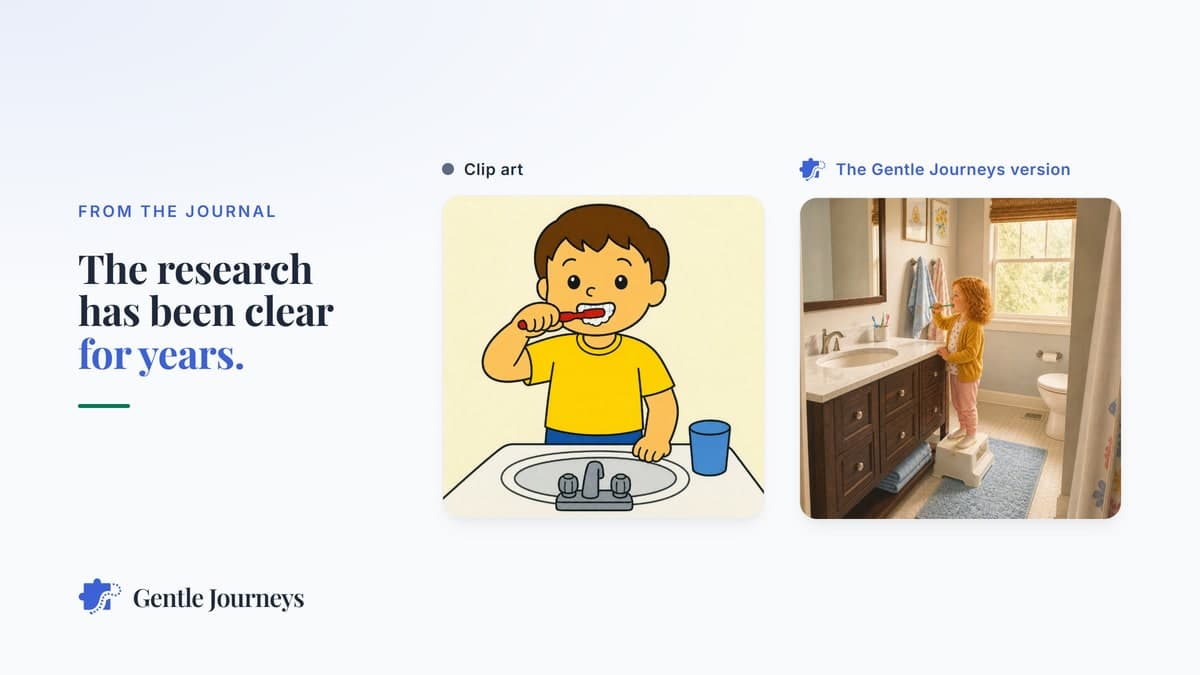
When a child with autism looks at a visual schedule step showing them brushing their teeth, the closer that image looks to their actual bathroom with their actual toothbrush, the more likely they are to connect the schedule to the routine. That's not my opinion. That's what Preissler (2008), Hartley & Allen (2015), Carter & Hartley (2021), and Wainwright et al. (2020) have demonstrated across hundreds of participants.
The product discipline in me requires substantiation. I can't just use any technology because it works. It needs to be the one that solves the problem the research says needs solving. "Good enough" isn't good enough when the data tells you better is possible and better actually matters for outcomes.
The Gap We're Closing
Here's the reality: the field has known since at least 2008 that realistic imagery outperforms simplified symbols for children with autism across labeling, retention, generalization, and symbolic understanding. The technology to act on that knowledge at a reasonable cost and at scale didn't exist. Now it does.
Gentle Journeys is the first tool I'm aware of that generates personalized, realistic visual supports for children with autism. Not stock photos. Not clip art with a child's name slapped on it. Imagery where the child sees themselves, consistently, across every experience the app creates for them.
The research was always clear. The tools just hadn't caught up. Now one has.
References:
- Carter, C. K., & Hartley, C. (2021). Are Children With Autism More Likely to Retain Object Names When Learning From Colour Photographs or Black-and-White Cartoons? Journal of Autism and Developmental Disorders, 51(9), 3050-3062.
- Hartley, C., & Allen, M. L. (2015). Symbolic Understanding of Pictures in Low-Functioning Children with Autism: The Effects of Iconicity and Naming. Journal of Autism and Developmental Disorders, 45(1), 15-30.
- Hutchins, T. L., & Sedeyn, C. (2021). Visual Attention to Photographs and BoardMaker Images in Social Stories. Education and Training in Autism and Developmental Disabilities, 56(1), 54-69.
- Preissler, M. A. (2008). Associative Learning of Pictures and Words by Low-Functioning Children with Autism. Autism, 12(3), 231-248.
- Wainwright, B. R., Allen, M. L., & Cain, K. (2020). The Influence of Labelling on Symbolic Understanding and Dual Representation in Autism Spectrum Condition. Autism & Developmental Language Impairments, 5, 1-14.